What Is a Protective Put Option?
Protective put options explained: payoff diagrams, the true cost of hedging, and when the strategy makes sense.
A protective put combines long stock with a long put. The put acts as insurance, limiting downside while keeping unlimited upside. You pay a premium for this protection, and only get it through the put’s expiration.
Protective Put Example
An investor bought 100 shares of TSLA at $300. The stock has risen to $430.90, $13,090 in unrealized gains. To protect those gains:
- Buy one 430 put for $28.00
- Cost of Protection: $2,800
The put guarantees a sale price of $430 per share, no matter how far TSLA falls. The effective floor is $402 (strike minus premium). With a $300 cost basis, this locks in a minimum profit of $10,200 through expiration.
Payoff Diagram
The protective put creates a “hockey stick” payoff: losses flatten below the strike while gains stay uncapped:
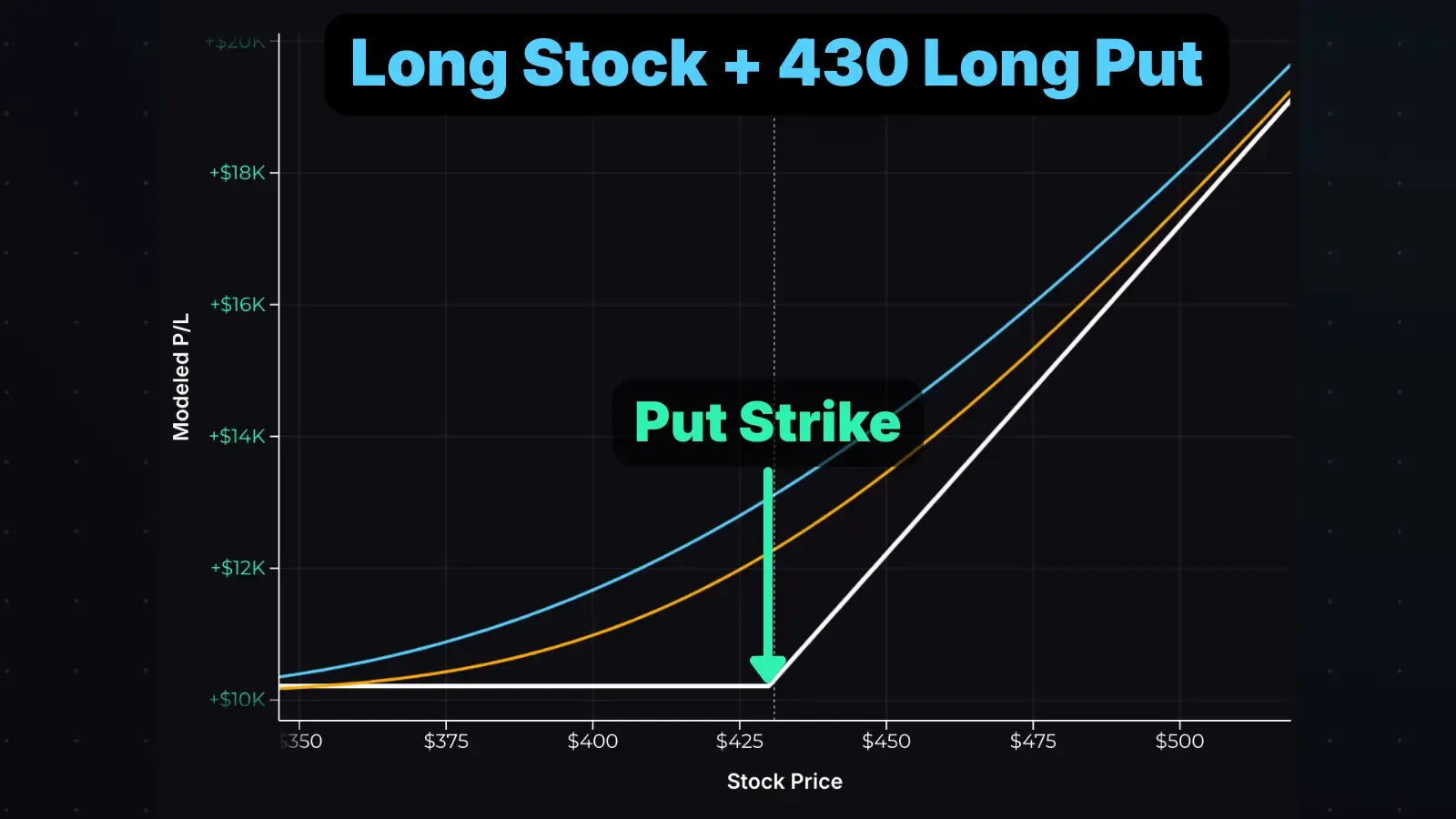
Long 100 TSLA at $300 cost basis, long 430 put at $28.00. 51 DTE.
The white line shows the payoff at expiration. Below $430, the P/L flattens at +$10,200. Above $430, the P/L slopes upward with the stock, minus the $2,800 premium.
The cyan line (T+0) shows the current theoretical value. The gap represents time value that decays if the stock stays above the strike.
Here’s the position with TSLA at $380 at expiration:
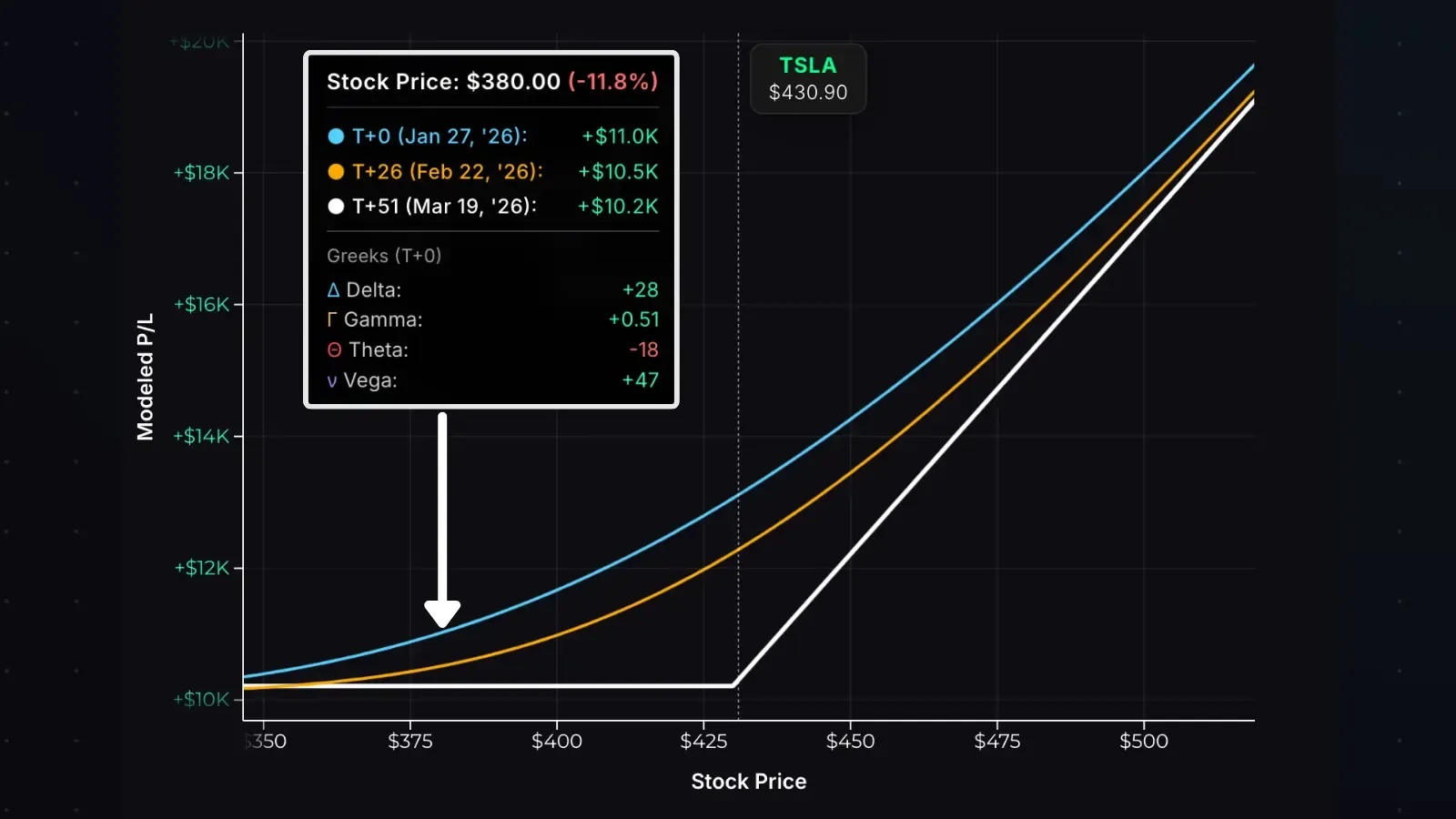
TSLA at $380 at expiration. The put is $50 ITM.
TSLA dropped $50 from when the put was purchased, but the position still profits $10,200.
The floor is $402: the $430 strike minus the $28 premium. Against a $300 cost basis, that’s $102 per share locked in, or $10,200 on 100 shares.
But how do you actually capture that floor?
You Don’t Have to Exercise
You don’t need to exercise the put to realize the protection. As the stock falls below the strike, the put gains intrinsic value. The combined position’s price won’t drop below the put strike - premium.
Example: TSLA at $350 with a 430-strike put.
- The put has $80 of intrinsic value ($430 − $350)
- Sell the stock for $350 + sell the put for $80 = $430 credit
- Less the $28 premium = $402 net credit
That’s $402 per share, or $40,200 total, locking in the same $10,200 profit as exercising.
Important: Selling often captures extra extrinsic value if time remains. If the long put isn’t deep ITM and has significant extrinsic value remaining, don’t exercise the put. Sell the stock and put instead.
The Cost of Protective Puts
Why not always buy puts against stock? Continuous hedging costs more than most stocks return.
TSLA 430-strike puts against a ~$43,000 position:
| Expiration | Put Price | Cost | % of Position | Annualized |
|---|---|---|---|---|
| 23 days | $20.00 | $2,000 | 4.7% | 74% |
| 51 days | $28.00 | $2,800 | 6.5% | 47% |
| 170 days | $53.00 | $5,300 | 12.3% | 26% |
| 723 days | $110.00 | $11,000 | 25.6% | 13% |
Rolling 23-day puts costs 74% annually. The 2-year put costs 25.6% upfront. TSLA needs to rise 26% just to break even on the hedge.
For investors sitting on large unrealized gains, the 2-year put might make sense: pay 13% annualized for guaranteed protection while staying long. But for routine hedging, the math doesn’t work.
Note: Options are cheapest when IV is low. But stocks like TSLA often see IV increase during rallies, making puts expensive exactly when you want them most.
Key Characteristics
- Max Profit: Unlimited (stock gains - premium)
- Max Loss: (Cost basis − strike + premium) × 100. The TSLA example had a minimum profit since the floor exceeds the cost basis.
- Outlook: Bullish, but want downside protection.
How the Greeks Affect a Protective Put
At entry, a protective put position has the following Greeks exposure:
| Greek | Exposure | What It Means |
|---|---|---|
| Delta (Δ) | Positive | Net bullish. The stock is +100 delta, the put is negative delta. |
| Gamma (Γ) | Positive | Delta moves toward zero as the stock falls, slowing losses. |
| Theta (Θ) | Negative | The put bleeds value daily. |
| Vega (ν) | Positive | Rising IV helps the put’s value. |
Key insight: if the stock collapses through the strike, the put’s delta approaches −100, offsetting the stock’s +100 delta. The position approaches zero delta, and further declines don’t hurt.
Protective Put vs Collar
A collar adds a covered call to offset the put’s cost.
| Protective Put | Collar | |
|---|---|---|
| Cost | Full premium | Reduced or zero |
| Max Profit | Unlimited | Capped at call strike |
| Protection | Same | Same |
| Use When | Want unlimited upside | Accept capped upside for cheaper protection |
Protective Put vs Stop-Loss Order
A stop-loss sells automatically at the trigger price. It’s free, but you’re out once it triggers, even on a flash crash that reverses.
The put gives you the right to sell, not the obligation. You control the timing through expiration. That control is what the premium buys.
- A protective put is long stock + long put. One put for every 100 shares. The downside is capped, and the upside is unlimited.
- Floor price = put strike - premium.
- You don’t have to exercise the put. Sell the put and stock for the same result, or better if the put has significant extrinsic value.
- Constant hedging is often expensive: 25%+ annually on high-IV stocks.
- Use for strategic, short-term protection, not as a permanent hedge.
- A protective put is long stock + long put. One put for every 100 shares. The downside is capped, and the upside is unlimited.
- Floor price = put strike - premium.
- You don’t have to exercise the put. Sell the put and stock for the same result, or better if the put has significant extrinsic value.
- Constant hedging is often expensive: 25%+ annually on high-IV stocks.
- Use for strategic, short-term protection, not as a permanent hedge.
Related Resources
- What Is a Long Put?: The building block of protective puts
- What Is a Covered Call?: Collect premium while holding stock
- What Is Implied Volatility?: Why protection costs vary
- Long Put Calculator: Model protective put payoffs